Showing posts with label Belgium. Show all posts

Sunday, December 10, 2017

Never in Broad Daylight: An Interview with Frank Roger


Frank Roger and I both have stories in the just-released Fall Into Fantasy 2017 anthology, published by Cloaked Press. Earlier I interviewed another contributor, Molly Neely.

Frank has written several hundred short stories. He is also the author of the science fiction novel Bonobo Sapiens. He currently lives in Ghent, Belgium.


1)  Frank, I don’t know if you were a fan, but I’d like to express my condolences on the passing of Johnny Hallyday. I understand he was the biggest rock-and-roll star in France and Belgium for over fifty years.

Honestly, I wasn’t a fan. Hallyday was mostly popular in the French-speaking part of the country. But music (both live and recorded) has been a lifelong passion: I grew up with the heavy and progressive bands of the 70s and beyond (Deep Purple, Black Sabbath, Nazareth, Yes, King Crimson, UFO, Magnum, Wishbone Ash, Styx, 38 Special, Samson and too many others to mention), as well as some different stuff (such as singer-songwriter Heather Nova).

2)   Like most Belgians, I assume you’re multilingual. Do you write in different languages, or just in English?

My native language is Dutch. When I began writing, I naturally did so in Dutch. Later on I switched to English, as this offered more market possibilities. I still write in Dutch too, and when I find the time, I translate (or retell) some of my stories into French (my second language). On top of that, many of my stories have been published in translation in a growing number of languages (over 40 by now, ranging from the very small (Manx) to the very big (Chinese)).

3)  That's amazing! I don't think my work has been in more than 10 languages so far. 

In an email, you mentioned that you went to the latest World Science Fiction Convention, which was held in Helsinki. In fact, you’re the only person I know who attended that convention. I assume you’ve been to other WorldCons. How did the Helsinki Con compare with other Cons you’ve attended?

I visited worldcons (and other conventions) in many countries in Europe, as well as in the USA, Canada and India. The Helsinki worldcon stood out because it was a very international worldcon, even more so than the one in London in 2014. The American and Canadian conventions I attended were noticeably less international in scope. The convention in India (where I was one of the Guests of Honor by the way) was an academic affair, supposed to be international, but attracting mostly people from all over India.
  
4)  Your story in Fall Into Fantasy, “Variant Readings,” is about 3,000 to 3,500 words long, correct? How do you decide what is the best length for a story?

Each story has its own natural length. That may be 50, 500, 5,000 or 50,000 words. I never trim or expand stories to fit a certain length. They always happen to be exactly as long as they need to be. My stories are not plot-driven or character-driven, but idea-driven: some ideas take more space to develop than others.

5)  You’ve written flash fiction, short stories, and novels. Which do you prefer?

I don’t think of myself as a novelist. I prefer doing short stories of varying lengths. I tend to think that novel writing and story writing are two very different talents, and few writers are blessed with both. My favorite short story writers are Philip K. Dick, J.G. Ballard and Jorge Luis Borges. Writers like Dick and Ballard (and perhaps I should also mention Robert Silverberg here) also did novels of course, but I always thought they excel at shorter work. My story “Variant Readings” was of course inspired by Borges. It is one of many stories of mine about strange books or bookstores.
 
6)  Before they submit their work, many writers run it by either a trusted critique group or a cadre of beta readers.  Do you, and how did you get that group?  (It took me many years to find a critique group that I found truly helpful.)

When a story is finished, I prefer submitting it right away. I trust an editor’s decision more than the view of someone who may or may not like a story for a variety of reasons, but whose opinion won’t lead to a publication. Some stories get picked up quickly, others take years to find a home. I have written about five hundred stories by now, and I believe that eventually they will all see print somewhere.

7)  Let’s finish up with a process question: how do you write?  Do you do it in the same time and place every day?

I take lots of notes. That’s how each story starts out. I only begin writing when I have a title, a beginning and an end. Improvisation doesn’t work for me. I try to do some writing every day, and I prefer working in the evening. Perhaps good stories never come to fruition in broad daylight?

On that we're in agreement: good stories are created at night!

Frank, thanks for sitting for this interview. Maybe we’ll get to meet at a future World Science Fiction Convention.

You can follow Frank Roger on Facebook at or on his website

Wednesday, May 30, 2012

It's Been a Long Time Coming


Last week, a payload from Space Exploration Technologies Corporation (SpaceX) reached the International Space Station.  This was an historic event: the first cargo sent to the Space Station by a private company!

As exciting as this is, it's been a long time coming.  My own history with private space launches goes back almost exactly 30 years.


Space Services, Inc., and the First Private Rocket Launch

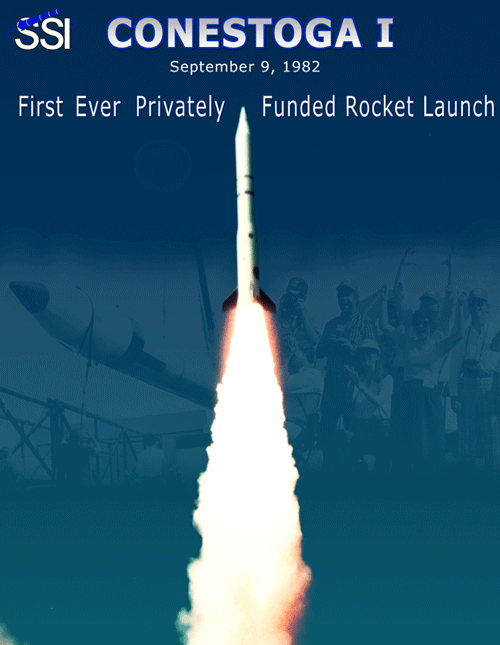
I was at the first-ever launch of a private space sub-orbital flight, Conestoga I, back in September of 1982.

At that time I was living in Houston, Texas.  I was not long out of college, where I had written a few articles for my college newspaper.  Later, I'd done man-in-the-street interviews for a free paper in the Lehigh Valley, Pennsylvania.  Covering this launch was the biggest thing I'd ever reported on.

A Houston company called Space Services, Inc., had cobbled together a launch vehicle, which they called Conestoga I.  It was to be launched from Matagorda Island (off the Gulf of Mexico).  I wrangled a press pass to the event and went down to the launch with several other Houston space enthusiasts.  We actually went down twice; the first scheduled launch was scrubbed.  But the second, after several hours of delay, came off successfully.

Even though the rocket was less than impressive (see the second photo above), it was an important event.  Until then, the US government had a monopoly on space launches in the USA.  We space enthusiasts hoped that this marked the beginning of dozens of private enterprise space efforts.  All of us were frustrated with the government-funded, plodding, design-by-committee work of NASA.  

We had also grown up reading Robert A. Heinlein's stories favoring private enterprise space efforts, such as "The Man Who Sold the Moon."  You want the jet pack the futurists of the 1950s and 60s promised you?  We wanted to go into space and stay at the Space Hilton.  This 1982 sub-orbital launch was supposed to be the start of that.

(There was high-tech on the ground, too.  It was on the ferry ride back to the mainland that I first saw a reporter writing her story with a portable computer!  Back in 1982, that computer probably cost more than the secondhand car I drove.)

We left the island with high hopes for Space Services, Inc (SSI).  The company insured good connections with NASA and the US government by hiring former Mercury 7 astronaut Deke Slayton as director.  But SSI never managed to become the gateway for space travel that we hoped for.  Today, they make their money shooting human ashes into space.  They also have a "Name the Star" subsidiary.  While I can't begrudge them finding a way to make money, it's quite a disappointment to someone who was at their first sub-orbital launch.


The German Space Company: Space Rockets or Missiles?

There were other disappointments over the years.

For a while, there was considerable excitement about a German launch company, OTRAG (which stood for Orbital Transport und Raketen AG ).  Unlike the scrounged, patched-together Conestoga I of SSI, OTRAG deigned a new engineering system for its rockets.

However, OTRAG elected to make money by basing its launch sites in countries ruled by dictators: first Zaire, then Libya.  The only reason those dictators allowed OTRAG to be based in their nations was the hope that OTRAG would give them missiles.  Thankfully, none of the dictators ever got effective missiles.

Of course, OTRAG had to be based outside of Europe.  This was back in the late 1970s and the 1980s; the USSR certainly wasn't going to allow OTRAG to put missiles in West Germany.  

Pressure from the international community eventually shut OTRAG down. But at least no one died.


The Assassination of Dr. Gerald Bull

Canadian ballistics scientist Dr. Gerald Bull wasn't so lucky.  He and his Space Research Company (SRC) were working towards building a "Supergun"- a gun so large it could literally shoot payloads into space.  His work in ballistics was so considered so valuable that he was made a US citizen by act of Congress.

But, by 1967, the US decided to pursue missiles over ballistic technology.  Both the Canadian and the US governments eventually stopped funding his efforts, so Gerry Bull and SRC found other sponsors.

Naturally, big guns have other uses besides launching satellites.  Gerry Bull found buyers who wanted to use his guns for military uses.  He and SRC first got into trouble in 1977 when it became public that they sold guns and restricted technology to South Africa, which was then under a UN arms embargo.  (The South Africans had no need for a Supergun, but they needed artillery to fight the Marxists in Angola.)

The scientist had become a gunrunner.

In a US court, Gerry Bull plead guilty for the South African sale.  He expected a slap on the wrist.  After all, the 60 barrels and 50,000 "semi-finished" shells he smuggled into South Africa had been built by a US arms manufacturer, with the apparent (if covert) approval of the US government.  In 1980 he was given a nominal four month sentence, but the jail time embittered Dr. Bull against the US government.  On the one hand, part of the government wanted him to help the South Africans fight the Marxists. On the other hand,  that same government prosecuted him and forced the liquidation of SRC.

After his release, Gerry Bull moved to Brussels, Belgium - then the center of the international arms industry.  In 1984, it became clear that Gerry Bull was now working for the People's Republic of China, helping them improve their arms industry.  He had other clients, too:  during the Iran-Iraq War, Iraq's forces used Bull-designed howitzers to great effect.  Saddam Hussein became interested enough to fund the Supergun, which Bull claimed would be able to fire a shell up to 6,000 miles.  

Israel is well within range of an Iraqi Supergun.

Of course, the Israelis would not allow the Supergun to be built.  Dr. Gerry Bull was assassinated outside his Brussels apartment in March of 1990.  It is widely believed that he was slain by Israeli MOSSAD agents.  The Iraqi Supergun was never completed.

Plenty of scientists still believe that some sort of gun would make a perfectly viable space launching system.  The preferred system now is called a "railgun."  But that has never been built, either.


21st Century Space Travel

After the millennium, private space efforts picked up.  SpaceX itself was not founded until 2002.  But the older space enthusiasts had been disappointed too often.  We developed a "show me" attitude after being disappointed once too often.

But now, at last, SpaceX has finally succeeded.  NASA has decommissioned their Space Shuttles, and private space companies are stepping up to fill that void.  

Now we're opening a new chapter for space exploration.  

It reminds me of the enthusiasm we had at that 1982 launch of the Conestoga.  

It reminds me of what it was like to be young.